US Treasury Bonds 2026: Yields and Investment Opportunities
The 2026 outlook for US Treasury Bonds is shaped by evolving inflation dynamics, Federal Reserve monetary policy, and geopolitical events, directly impacting yields and creating distinct investment opportunities for informed participants.
As we navigate the mid-2020s, understanding The 2026 Outlook for US Treasury Bonds: Yields and Investment Opportunities becomes paramount for investors seeking stability and growth in an ever-fluctuating global economy. The landscape of fixed-income investments is continually reshaped by macroeconomic forces, monetary policy shifts, and geopolitical developments, making a nuanced perspective essential for strategic portfolio construction. This deep dive aims to illuminate the key drivers and potential pathways for Treasury bonds in the coming years.
Understanding the Current Macroeconomic Climate
The global macroeconomic environment serves as the bedrock for assessing the future of US Treasury bonds. By 2026, several critical factors will likely have solidified their influence, determining the trajectory of yields and the attractiveness of these vital assets. Inflation, economic growth, and central bank actions are intertwined, each playing a significant role in shaping market expectations.
Current indicators suggest a complex interplay. While inflation has shown signs of moderation, its persistence remains a concern for many policymakers and market participants. The path to sustained price stability is rarely linear, and any resurgence could prompt a more hawkish stance from the Federal Reserve, directly impacting bond yields. Conversely, a significant economic slowdown could push yields lower as investors flock to safe-haven assets.
Inflationary Pressures and Federal Reserve Policy
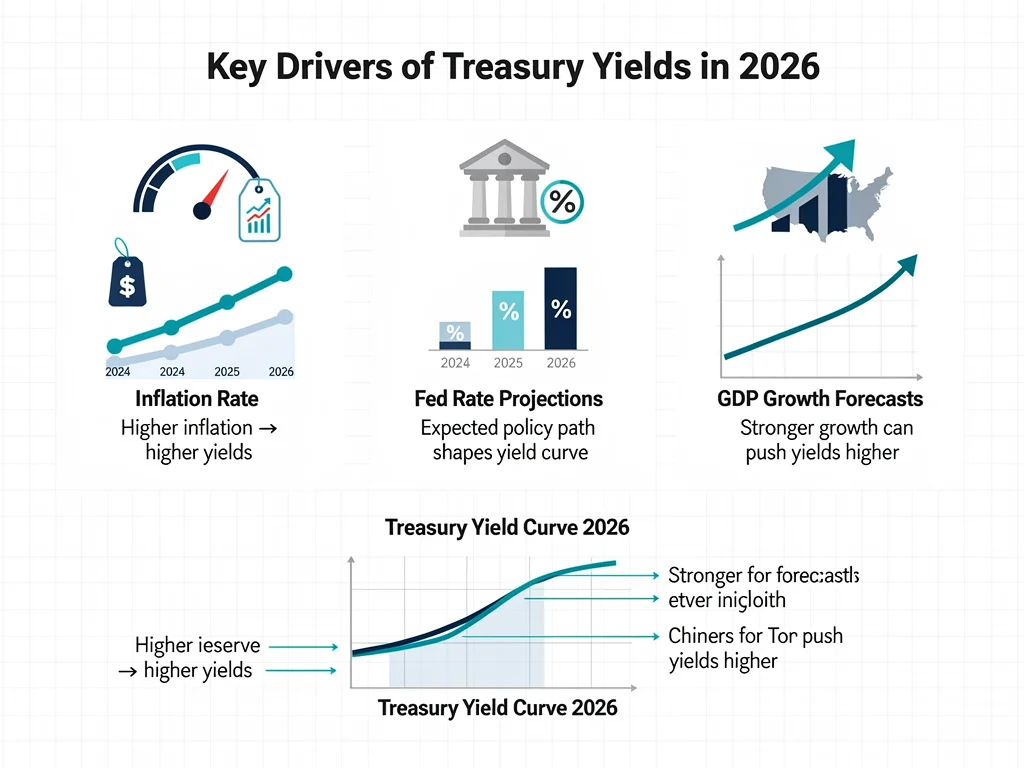
Inflationary pressures are perhaps the single most important determinant of Treasury yields. High inflation erodes the purchasing power of fixed payments, making bonds less attractive unless yields compensate for this loss. The Federal Reserve’s response to inflation, primarily through interest rate adjustments, is therefore crucial.
- Target Inflation Rate: The Fed’s commitment to its 2% inflation target will dictate its policy decisions.
- Interest Rate Hikes/Cuts: Future rate movements will directly influence short-term Treasury yields and ripple through the longer end of the curve.
- Quantitative Tightening: The Fed’s balance sheet reduction will continue to impact bond supply and demand dynamics.
The Fed’s communication and actions will be closely scrutinised, as any deviation from market expectations can lead to significant volatility in bond markets. Transparency and predictability in monetary policy are key to maintaining investor confidence and providing a clearer picture for 2026.
Projected Yield Trajectories for 2026
Forecasting bond yields is an intricate exercise, requiring an analysis of numerous variables. For 2026, several scenarios for US Treasury bond yields are plausible, each with distinct implications for investors. These projections are heavily reliant on the anticipated pace of economic growth, the effectiveness of inflation control, and the global demand for US debt.
One scenario posits a gradual normalisation, where inflation stabilises around the Fed’s target, allowing for a more dovish monetary policy. In this case, long-term Treasury yields might remain relatively stable or even decline slightly from current levels, reflecting lower inflation risk premiums. This would make existing bonds with higher coupons more attractive.
Factors Driving Yield Movements
Several fundamental factors will continue to drive Treasury yield movements:
- Economic Growth: Stronger GDP growth typically leads to higher yields, as investors anticipate increased demand for capital and potential inflationary pressures.
- Fiscal Policy: Government borrowing needs, driven by fiscal spending and deficits, influence the supply of Treasury bonds, affecting yields.
- Global Demand: International investor appetite for US Treasuries, often seen as a safe haven, can significantly impact demand and thus yields.
Another scenario involves persistent inflationary pressures or unexpected economic shocks. This could force the Fed to maintain a tighter monetary stance for longer, pushing yields higher across the curve. Such an environment would challenge fixed-income investors, requiring a re-evaluation of portfolio duration and credit risk.
Investment Opportunities in 2026 Treasury Bonds
Despite the inherent uncertainties, the 2026 outlook for US Treasury Bonds still presents a variety of investment opportunities for different investor profiles. The key lies in understanding how various bond maturities respond to economic conditions and aligning investment strategies with individual risk tolerance and financial goals.
Short-term Treasuries, such as T-bills and notes with maturities of one to three years, might offer attractive yields in a rising interest rate environment, providing liquidity and relatively lower interest rate risk. These can be particularly appealing for investors seeking to park cash safely while earning a reasonable return.
Long-Term vs. Short-Term Treasuries
The choice between long-term and short-term Treasuries depends heavily on an investor’s outlook on interest rates and inflation:
- Long-Term Bonds (10+ years): These are more sensitive to interest rate changes but offer higher yields and potentially greater capital appreciation if rates decline. They also provide a hedge against deflationary scenarios.
- Short-Term Bonds (1-3 years): Less sensitive to interest rate fluctuations, offering greater principal stability. Ideal for investors with shorter time horizons or those expecting further rate hikes.
Intermediate-term Treasuries (3-7 years) offer a balanced approach, providing a compromise between yield and interest rate sensitivity. These can be suitable for investors looking for stable income without taking on excessive duration risk. Furthermore, the diversification benefits of Treasuries within a broader portfolio remain a compelling reason for their inclusion, regardless of the yield environment.
Risks and Challenges for Treasury Investors
Investing in US Treasury bonds, while often considered low-risk, is not without its challenges. The 2026 outlook for US Treasury Bonds involves navigating several potential pitfalls, including interest rate risk, inflation risk, and liquidity risk. Understanding these challenges is crucial for making informed investment decisions and mitigating potential losses.
Interest rate risk is perhaps the most prominent concern. If interest rates rise unexpectedly, the market value of existing bonds with lower fixed coupon payments will fall. This is particularly true for longer-duration bonds, which are more sensitive to rate changes. Investors holding these bonds to maturity will still receive their principal and interest, but those who need to sell before maturity could incur capital losses.
Navigating Inflation and Geopolitical Risks
Inflation risk refers to the possibility that the purchasing power of a bond’s fixed payments and principal will be eroded by rising prices. While Treasury Inflation-Protected Securities (TIPS) offer a hedge against inflation, traditional Treasuries are vulnerable. Should inflation prove more persistent than anticipated, the real return on conventional bonds could diminish significantly.
- Unforeseen Inflation Spikes: Unexpected increases in inflation can quickly erode bond returns.
- Geopolitical Instability: Global conflicts or economic crises can trigger flight-to-safety events, but also impact fiscal policy and economic outlook.
- Fiscal Sustainability Concerns: Long-term concerns about government debt levels could influence investor confidence, though US Treasuries remain a global benchmark.
Geopolitical risks also play a role. While US Treasuries are generally seen as a safe haven during global instability, severe international crises could impact the US economy, leading to unforeseen policy responses or shifts in global capital flows. These factors, while less direct, can still influence the demand for and pricing of US government debt.
Strategic Approaches for 2026 Treasury Bond Investments
Given the nuanced landscape, developing a robust investment strategy for US Treasury bonds in 2026 is essential. This involves not only selecting the right maturities but also considering various approaches to portfolio construction that can adapt to changing market conditions. Diversification, active management, and a focus on real returns are key tenets.
For investors concerned about rising rates, a barbell strategy—combining very short-term and very long-term bonds—can be effective. The short-term component provides liquidity and allows for reinvestment at higher rates, while the long-term bonds offer higher yields and potential capital gains if rates eventually fall. Laddering, where an investor buys bonds with staggered maturities, is another popular strategy that helps mitigate interest rate risk by ensuring regular opportunities to reinvest at prevailing rates.

Diversification and Active Management
While Treasuries are a cornerstone of many portfolios, true diversification extends beyond just different maturities. Combining Treasuries with other fixed-income assets, such as corporate bonds, municipal bonds, or international government bonds, can enhance risk-adjusted returns. Each asset class responds differently to economic cycles, offering a buffer against volatility.
- Duration Management: Adjusting the average maturity of a bond portfolio to align with interest rate expectations.
- Yield Curve Analysis: Utilising insights from the shape of the yield curve to identify potential opportunities or risks.
- Inflation Protection: Incorporating TIPS into a portfolio to safeguard against unexpected inflation.
Active management, where portfolio managers make tactical adjustments based on market forecasts, can also be beneficial. This might involve shortening duration when interest rates are expected to rise or extending duration when rates are projected to fall. However, active management requires expertise and can incur higher fees, making it more suitable for certain investors.
The Role of US Treasuries in a Balanced Portfolio
Even with the evolving dynamics, US Treasury bonds will continue to play a critical role in a balanced investment portfolio through 2026 and beyond. Their status as a safe-haven asset, their liquidity, and their ability to diversify against equity market volatility make them indispensable for many investors, from institutional funds to individual savers.
Treasuries typically exhibit a low or negative correlation with equities, meaning they tend to perform well when stock markets are struggling. This inverse relationship provides a crucial ballast during periods of economic uncertainty or market downturns, helping to preserve capital and reduce overall portfolio risk. For this reason, even in a higher-yield environment, their role as a defensive asset remains paramount.
Capital Preservation and Diversification Benefits
For conservative investors or those approaching retirement, capital preservation is a primary objective. US Treasuries, backed by the full faith and credit of the US government, offer the highest level of credit quality, virtually eliminating default risk. This makes them an ideal component for the capital preservation segment of a portfolio.
- Risk Mitigation: Treasuries reduce overall portfolio risk due to their low correlation with other asset classes.
- Liquidity: The deep and liquid market for Treasuries ensures investors can easily buy or sell without significant price impact.
- Income Generation: While yields fluctuate, Treasuries provide a steady stream of income, which can be particularly valuable for retirees.
Furthermore, the diversification benefits of Treasuries extend beyond mere risk reduction. They can also enhance risk-adjusted returns by smoothing out portfolio volatility. By providing a stable component, Treasuries allow investors to potentially take on more risk in other, higher-growth asset classes, knowing they have a reliable anchor in their portfolio.
| Key Aspect | 2026 Outlook Summary |
|---|---|
| Yield Trajectory | Influenced by inflation, Fed policy, and economic growth; potential for stability or moderate increases. |
| Key Drivers | Inflation, Federal Reserve interest rates, fiscal policy, and global demand for safe-haven assets. |
| Investment Opportunities | Short-term for liquidity; long-term for potential capital gains; TIPS for inflation protection. |
| Primary Risks | Interest rate risk, inflation risk, and geopolitical events impacting market stability. |
Frequently Asked Questions about 2026 US Treasury Bonds
The main factors include the Federal Reserve’s monetary policy, particularly interest rate decisions, the prevailing inflation rate, the pace of US economic growth, and the level of government borrowing to fund fiscal policies. Global investor sentiment and geopolitical events also play significant roles.
Persistent high inflation would erode the real return on conventional Treasury bonds, making them less attractive unless yields rise substantially to compensate. Conversely, if inflation is well-contained, the stable, albeit lower, returns of Treasuries become more appealing for capital preservation.
The optimal choice depends on interest rate expectations. Short-term bonds offer greater stability in a rising rate environment and liquidity. Long-term bonds provide higher yields and potential capital gains if rates fall, but carry more interest rate risk if rates increase.
US Treasury bonds serve as a crucial component for diversification and capital preservation. They typically have a low or negative correlation with equities, providing a hedge against stock market volatility and economic downturns, thus helping to stabilise overall portfolio returns.
The primary risks include interest rate risk, where rising rates decrease bond values, and inflation risk, which erodes purchasing power. While credit risk is minimal, liquidity risk can be a factor for less common issues, and geopolitical events can also influence market sentiment.
Conclusion
The 2026 outlook for US Treasury Bonds is multifaceted, shaped by a complex interplay of economic fundamentals, monetary policy, and global events. While the exact trajectory of yields remains subject to these evolving forces, Treasuries will undoubtedly continue to be a foundational element in well-constructed investment portfolios. Investors who carefully consider the potential for inflation, the Federal Reserve’s stance, and their own risk tolerance will be best positioned to harness the stability and potential opportunities these instruments offer. Strategic allocation, whether through short-term liquidity, long-term growth potential, or inflation-protected securities, will be key to navigating the bond market effectively in the coming years. Ultimately, US Treasury bonds will remain a vital anchor, providing both stability and a hedge against broader market volatility.
Related Posts: