Pre-Tax Commuter Benefits 2026: Save $325 Monthly
Advertisements
Pre-Tax Commuter Benefits in 2026 allow eligible U.S. employees to pay for qualifying transportation expenses with tax-advantaged compensation. The IRS permits up to $340 per month for transit and commuter highway vehicles and a separate $340 monthly exclusion for qualified parking, potentially reducing taxable wages and commuting costs.
Pre-Tax Commuter Benefits in 2026 provide an opportunity for American workers to manage eligible transportation expenses while reducing the income subject to certain payroll and income taxes.
For 2026, the Internal Revenue Service has established separate monthly exclusions of $340 for qualified transit expenses and $340 for eligible parking, replacing the $325 limits that applied in 2025.
This guide explains how commuter benefit programs work, who may qualify, which expenses are covered, and how to estimate potential tax savings without confusing contribution limits with actual money saved.
Understanding Pre-Tax Commuter Benefits in 2026
Commuter benefits are employer-provided arrangements that allow eligible employees to cover certain transportation expenses using money excluded from taxable wages.
These programs are governed by federal tax rules for qualified transportation fringe benefits, including public transit passes, qualifying commuter highway vehicles, and certain parking arrangements.
They can form part of a broader workplace benefits package, although their availability depends on employer participation and any applicable state or local requirements.
What Changed for the 2026 Tax Year?
The IRS increased the monthly exclusion for transit passes and qualifying commuter highway transportation from $325 in 2025 to $340 in 2026.
The separate monthly exclusion for qualified parking also increased from $325 to $340 for the 2026 tax year.
These limits apply to eligible expenses, not to guaranteed tax savings or additional payments automatically provided to workers.
How the Two Monthly Limits Work
Under federal rules, eligible transit passes and commuter highway vehicle transportation share one monthly exclusion limit of $340.
Qualified parking has its own separate monthly limit of $340, meaning an employee may potentially use both categories during the same month.
Someone with sufficient expenses in both categories could therefore receive up to $680 in monthly tax-excluded transportation benefits, subject to the employer's program rules.
Why Commuter Benefits Matter
Transportation costs can represent a recurring expense for workers who travel regularly between home and their workplace.
Paying eligible expenses through a pre-tax arrangement may reduce the tax cost of commuting compared with paying the same amount entirely from after-tax earnings.
However, the financial advantage depends on actual commuting expenses, tax circumstances, and the way the employer administers the benefit.
The Mechanics of Pre-Tax Savings: Up to $340 Monthly Per Category

The basic principle of pre-tax commuter benefits involves using eligible compensation to pay for qualifying commuting expenses before certain taxes are calculated.
For workers using a salary-reduction arrangement, the elected amount is generally deducted from eligible compensation and used for approved transit or parking expenses.
Because the excluded amount is not treated as taxable wages for certain purposes, employees may pay less in taxes than they would without the benefit.
How the $340 Monthly Limit Impacts Commuters
An employee spending $180 per month on qualifying public transportation may generally elect to use $180 in pre-tax commuter benefits if the employer's program permits it.
A worker spending $340 on qualifying parking may use the full monthly parking exclusion, assuming the expense and program satisfy the applicable requirements.
Neither employee automatically receives $340 in cash savings. The actual advantage comes from the taxes that would otherwise apply to the excluded compensation.
Understanding Tax Exclusions Versus Tax Savings
A tax exclusion reduces the amount of compensation subject to certain taxes, while a tax saving is the amount of tax that is actually avoided.
For example, excluding $200 from taxable wages does not mean receiving an additional $200 in take-home pay.
Instead, the employee generally avoids applicable taxes on that $200, so the value of the benefit depends on the relevant tax rates and personal circumstances.
Which Taxes May Be Reduced?
Qualified transportation benefits are generally excluded from federal income-tax withholding and Social Security and Medicare wages within applicable limits.
State and local tax treatment may differ, so employees should not assume that every jurisdiction provides identical advantages.
Payroll departments and qualified tax professionals can help explain how the exclusion affects a particular employee's compensation and withholding.
Eligibility and Enrollment for 2026 Commuter Programs
Eligibility generally depends on having an employment arrangement that provides access to qualifying transportation benefits.
Workers may be able to participate when they incur eligible commuting expenses and their employers offer the required benefit arrangements.
Self-employed individuals generally cannot establish the same qualified transportation fringe-benefit exclusion for themselves solely through self-employment income.
Who Can Participate?
Employees commuting through eligible transit services, qualified commuter highway vehicles, or qualifying parking arrangements may be candidates for participation.
The specific enrollment conditions depend on the employer's policies, the benefit administrator, and any applicable local legislation.
Employees should contact human resources rather than assuming that the availability of public transportation automatically creates eligibility.
How Enrollment Usually Works
Many employers provide enrollment through an online benefits portal or a third-party commuter benefit administrator.
Participants typically select an eligible monthly contribution amount and arrange for payroll deductions or another approved method of receiving the benefit.
After enrollment, the program may provide payment cards, transit passes, vouchers, or reimbursement procedures depending on the expense category.
Can Contributions Be Changed?
Some commuter benefit arrangements allow employees to adjust future contributions as their transportation needs change.
The applicable deadlines and procedures depend on the employer's program and administrator, and should be reviewed before making an election.
Workers who change jobs, begin remote work, or reduce commuting days should review their elections to avoid accumulating unnecessary balances.
Employer Responsibilities and Benefits
Employers play an important role in administering qualified transportation benefits and ensuring that amounts are handled according to federal tax requirements.
Companies may provide eligible benefits directly or arrange compliant salary reductions through payroll systems.
Different methods create different administrative requirements, so program design should be reviewed carefully before implementation.
Potential Payroll Tax Advantages
When qualifying transportation benefits are excluded from Social Security and Medicare wages, employers may also reduce their share of applicable payroll taxes.
The amount of potential savings depends on the benefit structure, the employee's wage circumstances, and the payroll taxes that would otherwise apply.
Employers should also consider administrative costs, program rules, and the federal tax treatment of transportation expenses when evaluating a plan.
Employee Recruitment and Retention
Commuter benefits may make a compensation package more attractive to workers who regularly travel to a physical workplace.
Providing access to tax-advantaged transportation can demonstrate attention to the recurring costs associated with employment.
However, the value of the benefit varies among employees, particularly when some work remotely or do not incur eligible commuting expenses.
Are Employers Required to Offer These Benefits?
Federal tax law permits qualifying transportation fringe-benefit arrangements but does not require every private employer in the United States to provide them.
Some state and local governments establish commuter benefit requirements for employers meeting specified conditions.
Workers and employers should review the rules that apply to their location rather than assuming that every company follows the same legal obligations.
Navigating Qualified Transit and Parking Expenses
Understanding which transportation expenses qualify is essential for using commuter benefits correctly.
Federal regulations identify specific categories, and not every expense related to traveling to work falls within the exclusion.
Before enrolling, employees should confirm that their preferred transportation arrangements are covered by the program.
Eligible Public Transportation
Qualified transit passes generally include eligible fares for transportation systems such as buses, subways, commuter trains, and other qualifying mass-transit services.
Passes, farecards, vouchers, and similar instruments may qualify when they meet the relevant tax requirements.
The manner in which an employee purchases or receives the transit benefit can also affect the available reimbursement method.
Qualified Commuter Highway Vehicles
Some employer transportation and vanpool arrangements qualify for the commuter highway vehicle exclusion.
Federal rules establish conditions involving passenger capacity, expected vehicle use, and commuting-related occupancy.
An ordinary carpool or private ride does not automatically qualify, so employees should verify the arrangement before using pre-tax funds.
Qualified Parking Expenses
Qualified parking generally includes eligible parking at or near the employer's business premises.
It may also include parking at a location from which the employee continues commuting to work through qualifying transportation arrangements.
Parking at or near an employee's residence does not qualify merely because the vehicle is used to commute.
Expenses That Usually Do Not Qualify
Ordinary personal vehicle expenses, including gasoline, maintenance, repairs, and highway tolls, generally do not qualify as transportation fringe benefits.
Regular taxi or rideshare trips are not automatically eligible transit expenses, even when used for commuting to work.
Employees should also avoid assuming that bicycle-related commuting expenses qualify for the same exclusion, particularly after the elimination of the federal qualified bicycle commuting reimbursement exclusion beginning in 2026.
Impact of Pre-Tax Commuter Benefits on Financial Planning
Including commuter benefits in personal financial planning can help workers estimate their transportation expenses more accurately.
The main advantage is a potential reduction in tax liability on qualifying commuting costs rather than a direct reduction in transit fares or parking prices.
Workers should compare the expected tax benefits with actual expenses and any limitations imposed by their employer's program.
Case Studies: Illustrative Tax Savings Examples
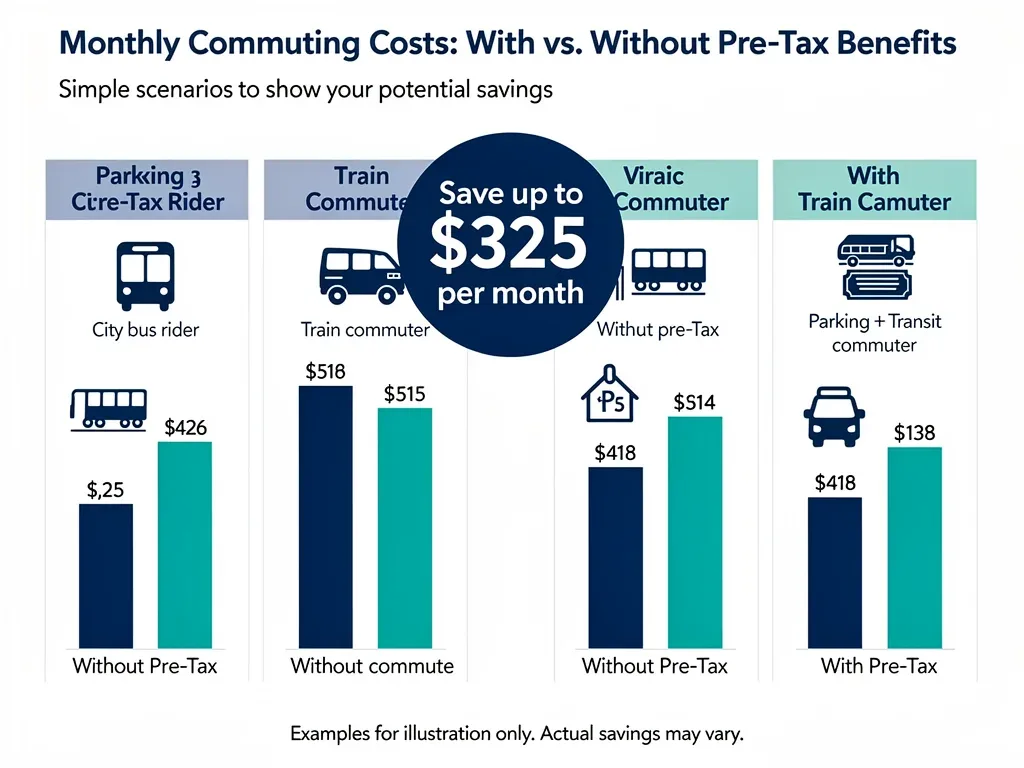
Consider an employee who pays $200 per month for eligible public transportation, representing $2,400 in qualifying annual expenses.
If the relevant combined tax reduction were approximately 25% of the excluded compensation, the employee's illustrative annual tax savings would be around $600.
This example is hypothetical. The employee's actual tax savings could be different because tax rates, wage limits, and state or local rules vary.
Example: Parking Expenses of $300 Per Month
Another employee might spend $300 monthly on qualified parking near their workplace, or $3,600 over 12 months.
At an illustrative combined tax rate of 25%, excluding the full amount could reduce taxes by approximately $900 annually.
The employee would still incur the underlying parking expense; the savings come from paying the qualifying cost with compensation that receives favorable tax treatment.
Example: Using Both Categories
Suppose a worker incurs $250 in eligible transit expenses and $150 in qualified parking expenses during one month.
If both expenses meet the rules and the employer's plan permits them, the employee could potentially exclude the combined $400 because each category remains within its separate monthly limit.
The maximum combined exclusion can reach $680 in a month, but the actual amount used should reflect real eligible expenses rather than the largest allowable election.
Why Individual Results Differ
Two employees with identical commuting expenses may experience different tax outcomes because their income, withholding, and state tax circumstances differ.
Eligibility for particular payroll-tax exclusions can also depend on wage conditions and statutory rules.
For a more precise estimate, employees should review payroll information or consult an appropriate tax professional instead of relying on generic savings promises.
Common Mistakes to Avoid With Commuter Benefits
Transportation benefits can be useful, but misunderstandings about limits and eligible expenses may create unnecessary complications.
One common mistake is treating the monthly exclusion limit as a guaranteed payment or discount from the government.
Another is assuming that every transportation-related purchase qualifies simply because it occurs during a commute.
Confusing the Separate Monthly Limits
The 2026 exclusion for transit passes and commuter highway vehicle transportation is $340 per month.
Qualified parking has its own $340 monthly exclusion, and the two limits are not combined into a single $340 cap.
However, a worker cannot automatically use the full $680 without incurring expenses that qualify under both categories.
Electing More Than You Need
Commuting expenses can change when an employee works from home, takes leave, or switches transportation methods.
Electing substantially more than expected monthly spending may create an unused balance that is difficult to access under the plan's rules.
Employees should understand carryover, reimbursement, and termination provisions before deciding how much compensation to set aside.
Assuming All Reimbursements Are Allowed
Federal regulations impose conditions on reimbursement arrangements, including special restrictions relating to transit passes.
Employees should use approved payment methods and retain documentation when the administrator requires it.
A reimbursement that does not satisfy the applicable rules may fail to receive the intended tax treatment.
Future Outlook: What to Expect Beyond 2026
The IRS generally announces inflation-related adjustments to qualified transportation benefit limits for future tax years.
However, the monthly exclusions for years after 2026 should not be assumed until the applicable amounts are officially published.
Employers and participants should continue monitoring IRS guidance as well as relevant local requirements that may affect program availability.
How Inflation Adjustments Affect Limits
The statutory exclusion limits are subject to adjustments under federal tax rules.
For 2026, the IRS established $340 as the monthly amount for each of the two qualified transportation categories.
Future limits may change, but the size and timing of those adjustments cannot be guaranteed in advance.
Changes in Commuting Habits
Remote and hybrid work arrangements may reduce the number of days some employees need transportation benefits.
Other workers may continue paying substantial transit or parking expenses because they travel to a workplace regularly.
Reviewing actual commuting patterns can help employees select contribution amounts that match their needs.
Local Commuter Benefit Requirements
Some jurisdictions maintain commuter benefit ordinances or related transportation programs for eligible employers.
The requirements may depend on business size, work location, and the types of benefits an employer already provides.
For example, the San Francisco Bay Area has a regional Commuter Benefits Program that establishes requirements for covered employers.
Maximizing Your Pre-Tax Commuter Benefits
The most useful strategy is to understand the employer's program and make contribution choices based on actual eligible expenses.
Employees should review available payment methods, monthly limits, and the procedures for adjusting future elections.
It is also important to monitor spending during the year instead of assuming that the maximum monthly exclusion is always the best contribution amount.
Step 1: Calculate Your Monthly Commuting Expenses
Begin by reviewing what you normally spend on transit fares, qualifying commuter vehicle transportation, and eligible parking.
Separate expenses that qualify under federal rules from other costs such as gasoline, tolls, and routine vehicle maintenance.
Use your actual commute schedule to estimate the amount that is likely to be necessary each month.
Step 2: Review Your Employer's Program
Contact human resources or the benefits administrator to confirm which categories are supported and how employees participate.
Ask about enrollment deadlines, payroll deductions, payment methods, and any restrictions on unused balances.
Confirm whether the employer provides additional subsidies or operates the arrangement entirely through employee salary reductions.
Step 3: Choose a Realistic Contribution
Use the amount you reasonably expect to spend rather than automatically selecting the statutory maximum.
If monthly commuting costs fluctuate, review the plan's flexibility for changing future elections.
Remember that the federal limit establishes the maximum eligible tax exclusion, not the amount every employee must contribute.
Step 4: Monitor Your Tax Savings
Review your pay statements to understand how commuter benefit contributions affect taxable compensation and payroll deductions.
Compare your transportation spending with the amount excluded through the program.
When necessary, consult payroll or a tax adviser to understand how the arrangement affects your individual tax situation.
Pre-Tax Commuter Benefits in 2026: Key Takeaways
Pre-Tax Commuter Benefits in 2026 can help eligible workers reduce certain taxes associated with qualified commuting expenses.
The most important distinction is that federal rules permit up to $340 per month for transit and qualified commuter highway transportation, plus a separate $340 exclusion for eligible parking.
The table below summarizes the limits, eligibility considerations, and employer responsibilities.
Key Aspect | Brief Description |
|---|---|
Monthly Limit | Up to $340 monthly for eligible transit and commuter highway transportation, plus a separate $340 monthly exclusion for qualified parking. |
Savings Impact | Reduces certain taxable wages; actual tax savings depend on eligible expenses and individual tax circumstances. |
Eligibility | Generally available through qualifying employer arrangements for employees with eligible transit or parking expenses. |
Employer Role | Administers the benefit, follows payroll and tax requirements, and may receive applicable payroll tax advantages. |
Frequently Asked Questions About Commuter Benefits
What exactly are Pre-Tax Commuter Benefits in 2026?
Pre-Tax Commuter Benefits in 2026 are qualifying employer arrangements that allow eligible transportation expenses to be paid using compensation excluded from certain taxes. The federal monthly limits are $340 for transit passes and commuter highway vehicle transportation combined, and a separate $340 for qualified parking. Participation and payment methods depend on the employer's program.
How much can I save monthly with these benefits?
The amount you can exclude from taxable compensation is not the same as your actual tax savings. In 2026, the maximum exclusion is $340 per month for eligible transit expenses and another $340 for qualified parking. Your savings depend on how much you spend, the benefit arrangement, and the taxes that would otherwise apply.
What types of expenses are covered by the benefits?
Eligible expenses generally include qualifying public transit passes, certain commuter highway vehicle transportation, and parking at or near the workplace or qualifying transit connection points. Ordinary gasoline, car maintenance, highway tolls, and most personal rideshare expenses do not qualify for the same exclusion.
Are all employers required to offer Pre-Tax Commuter Benefits?
No. Federal tax rules permit qualifying transportation benefit arrangements, but they do not require every employer to offer them. Certain states and local jurisdictions have commuter benefit requirements for covered employers. Check with your human resources department and review the rules that apply to your work location.
How do I enroll in a Pre-Tax Commuter Benefits program?
Enrollment generally takes place through an employer's human resources department or designated benefits administrator. Employees typically select eligible contribution amounts and follow the program's payroll deduction or payment procedures. Before enrolling, confirm the available categories, monthly limits, deadlines, and rules for unused funds.
Looking Ahead: Making the Most of Commuter Benefits
The 2026 limits for qualified transportation benefits provide eligible employees with an opportunity to reduce the tax cost of certain recurring commuting expenses.
However, the financial advantage depends on actual qualifying expenses rather than a guaranteed monthly payment or reimbursement from the government.
By understanding the separate $340 limits, reviewing employer rules, and selecting realistic contributions, workers can use commuter benefits as part of a more informed approach to personal financial management.