Claiming 2026 Secure Act 2.0 Student Loan Match Benefits
Advertisements
The SECURE Act Student Loan Match allows eligible American employees to receive employer retirement contributions based on qualified student loan payments, creating opportunities to build retirement savings while managing educational debt in 2026.
The SECURE Act Student Loan Match offers American employees an opportunity to build retirement savings while continuing to repay qualified educational loans.
This optional workplace benefit helps address financial challenges faced by employees balancing student debt, household expenses, and long-term retirement planning.
This guide explains eligibility requirements, payment certification, contribution limits, and the practical steps employees can take to access available matching benefits.
Understanding the SECURE Act 2.0 Student Loan Match Provision
The SECURE 2.0 Act was enacted in December 2022, introducing several changes designed to expand retirement savings opportunities throughout the United States.
Section 110 allows participating employers to make retirement matching contributions based on qualified student loan payments made by eligible employees.
The SECURE Act Student Loan Match became available for retirement plan years beginning after December 31, 2023, subject to employer adoption.
How the Student Loan Matching Benefit Works
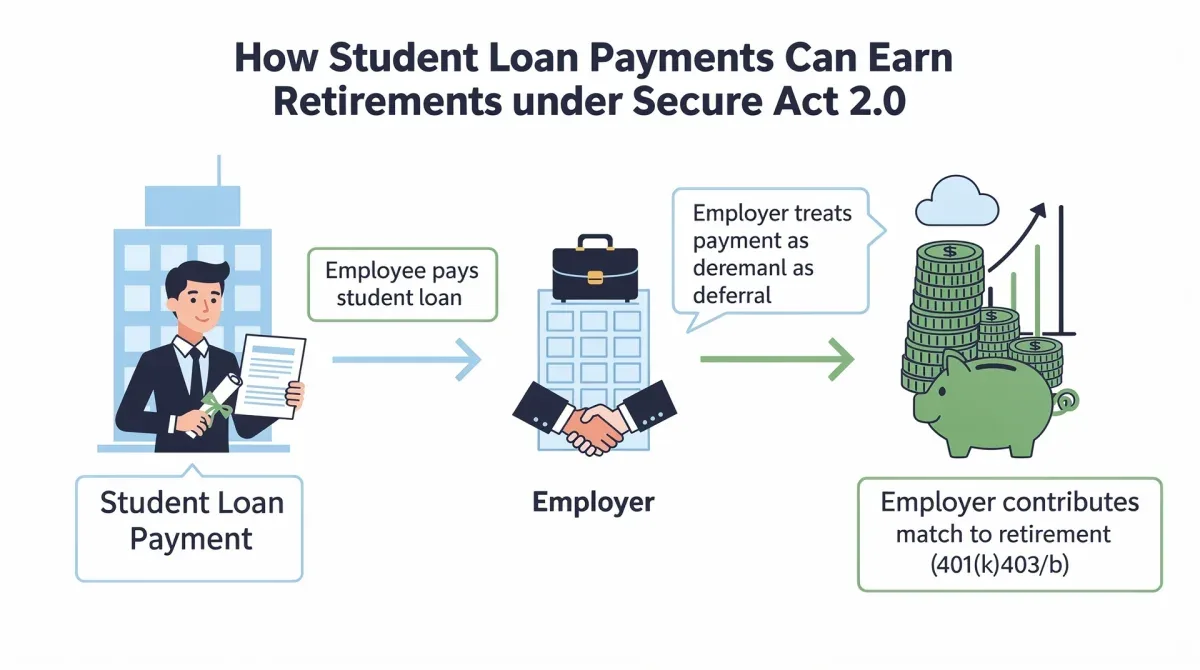
Employees typically receive employer matching contributions when they contribute part of their compensation directly into an eligible workplace retirement account.
This provision allows employers to recognize qualifying student loan payments when calculating retirement matching contributions under applicable retirement plan conditions.
The employer deposits the matching amount into the retirement account rather than directly reducing the employee's outstanding educational loan balance.
Which Retirement Plans Can Offer the Benefit?
Eligible arrangements include 401(k) plans, 403(b) plans, SIMPLE IRA plans, and governmental 457(b) retirement plans that adopt this optional feature.
Employers must establish appropriate administrative procedures before participants can receive matching contributions based on their qualifying student loan payments.
Employees should confirm whether their workplace retirement plan currently offers the SECURE Act Student Loan Match before assuming eligibility.
Eligibility Criteria for the 2026 Student Loan Match
Eligibility depends on the employer's retirement plan provisions, the employee's participation requirements, and the qualification of individual student loan payments.
Employers are not universally required to offer this benefit, even when their existing retirement plans provide conventional employee contribution matches.
Understanding these conditions helps employees determine whether they can access the SECURE Act Student Loan Match during the 2026 plan year.
Defining Qualified Student Loan Payments
Qualified payments generally involve educational loans obtained specifically to cover eligible higher education expenses under applicable federal tax law.
These expenses may include tuition, required fees, books, supplies, and qualifying accommodation expenses associated with attendance at eligible educational institutions.
Employees should confirm that their individual educational loans meet the applicable qualification requirements before submitting payment information to their retirement plan.
Can Employees Qualify With Private Student Loans?
Both federal and private student loans may qualify when the underlying educational debt satisfies applicable federal definitions of qualified education loans.
The source of financing does not automatically determine whether payments qualify for employer retirement matching contributions under this provision.
Eligibility for the SECURE Act Student Loan Match depends on the characteristics of the loan and the employee's qualifying repayment activities.
Student Loans for Spouses and Dependents
Qualified educational loans may include debt incurred by employees to pay eligible higher education expenses for themselves, their spouses, or dependents.
However, employees must have the applicable legal obligation to repay the loan and satisfy the certification requirements established by their retirement plans.
Voluntarily paying another person's educational debt does not automatically qualify the employee for retirement matching contributions under the federal provision.
Refinanced Student Loans and Eligibility
Refinanced educational debt may qualify when the new loan satisfies the applicable requirements and originates from qualifying higher education indebtedness.
Refinancing arrangements involving additional personal borrowing or unrelated financial obligations may require further examination before eligibility can be established.
Employees with refinanced loans should consult their plan administrator before including these repayments in a SECURE Act Student Loan Match certification.
The Process: How to Claim Your Match
Claiming the student loan matching benefit begins with understanding the procedures established by the employer and the designated retirement plan administrator.
Employees should review their eligibility, confirm qualifying loan payments, and complete the certification process within the deadlines specified by their plans.
The SECURE Act Student Loan Match is generally accessed through workplace benefit administration rather than through a separate federal income tax application.
Step 1: Confirm Your Employer Offers the Benefit
Contact your human resources department or retirement plan administrator to determine whether student loan matching contributions are currently available.
Review your retirement plan documents for information concerning eligibility dates, matching formulas, vesting requirements, and applicable certification procedures.
Understanding your employer's available benefits helps distinguish this retirement provision from other opportunities involving student loan forgiveness eligibility.
Step 2: Gather Your Student Loan Payment Records
Collect relevant loan statements, payment confirmations, and other records demonstrating qualifying educational debt repayments completed during the applicable retirement plan year.
Maintaining organized records can help employees respond efficiently when plan administrators request information about individual loan payments or educational financing.
These records provide useful supporting information when completing the certification process for the SECURE Act Student Loan Match.
Step 3: Complete the Required Certification
Employees must certify their qualifying student loan payments at least annually using procedures that satisfy applicable federal requirements and plan conditions.
Employers may use different verification methods, including employee certifications, third-party administrative services, and other permitted approaches to confirming relevant information.
Submitting additional loan statements is not universally required when the employer uses an alternative certification method permitted under IRS guidance.
Step 4: Review Your Matching Contribution
After completing certification, review your retirement account to confirm that applicable matching contributions have been calculated and deposited according to plan procedures.
Contact your plan administrator if contribution amounts appear inconsistent with the established matching formula or if expected deposits remain outstanding.
Monitoring account activity helps employees understand how the SECURE Act Student Loan Match affects their accumulated retirement savings throughout the year.
IRS Guidance and Federal Requirements
The Internal Revenue Service has issued guidance addressing implementation questions associated with employer matching contributions based on qualifying student loan payments.
These federal requirements help retirement plan sponsors establish appropriate eligibility conditions, certification procedures, matching arrangements, and operational processes.
Employees should distinguish official SECURE Act Student Loan Match requirements from additional administrative procedures established by individual employers.
Understanding IRS Notice 2024-63
The official IRS Notice 2024-63 addresses several implementation requirements for retirement plans offering qualified student loan payment matching contributions.
The guidance explains qualifying payments, employee certification, matching arrangements, contribution timing, and certain requirements affecting eligible retirement plans.
Employers and employees can consult this information alongside current retirement plan documentation when evaluating their individual responsibilities and available benefits.
Employer Matching Formulas and Contribution Conditions
Student loan matching generally follows the applicable matching rate and related eligibility conditions used for conventional employee retirement contribution matches.
Employees should review their specific formulas because employers may establish different matching percentages and compensation limits within their retirement plans.
The SECURE Act Student Loan Match does not automatically provide an unlimited additional employer contribution beyond the applicable matching arrangement.
Understanding Contribution Timing
Employers may calculate and deposit qualifying student loan matching contributions on a different schedule from their conventional retirement contribution matching arrangements.
Applicable federal guidance permits arrangements involving less frequent deposits, provided the required matching contribution frequency satisfies relevant retirement plan rules.
Employees should confirm whether their workplace benefit provides monthly, quarterly, annual, or other permitted matching contribution schedules before anticipating account deposits.
2026 Retirement Contribution Limits
Retirement contribution limits represent an important consideration when employees combine qualifying educational loan payments with direct workplace retirement savings contributions.
The applicable limits vary according to the retirement plan type, employee compensation, age, and other relevant federal contribution requirements.
Understanding these restrictions helps employees evaluate their SECURE Act Student Loan Match without expecting unrestricted matching contributions from their employers.
401(k) Employee Contribution Limits for 2026
The standard elective deferral limit for most 401(k) retirement plans is $24,500 during the 2026 calendar year.
Eligible employees aged fifty or older may generally contribute an additional $8,000, subject to applicable retirement plan and federal requirements.
Qualifying participants aged sixty through sixty-three may access a higher catch-up contribution limit of $11,250 during the 2026 calendar year.
Understanding the Qualified Student Loan Payment Limit
For a standard 401(k), qualifying student loan payments considered for matching are subject to a separate calculation based on federal limits.
The calculation generally uses the standard elective deferral limit or eligible compensation, whichever is lower, reduced by applicable employee elective deferrals.
Consequently, employees cannot assume that unlimited educational loan repayments will generate additional retirement matching contributions beyond the established federal limitations.
Combined Employee and Employer Contribution Limits
The annual additions limit for applicable defined contribution retirement plans is generally $72,000 for 2026, excluding eligible catch-up contributions.
This limit generally includes employee contributions, employer matching contributions, and other qualifying amounts deposited into the relevant retirement account.
The SECURE Act Student Loan Match must operate within applicable contribution restrictions, including separate requirements for different types of retirement plans.
Practical Examples of Student Loan Matching Contributions
Illustrative examples can help employees understand how qualifying student loan payments may translate into additional employer contributions toward retirement savings.
The following scenarios assume that the employer has adopted the benefit and that all applicable eligibility and certification requirements are satisfied.
Actual SECURE Act Student Loan Match amounts depend on individual compensation, repayment activity, matching formulas, and the retirement plan's established conditions.
Example 1: Employee Earning $60,000 Annually
Consider an employee earning $60,000 annually whose employer offers a dollar-for-dollar retirement contribution match up to five percent of eligible compensation.
The maximum annual matching contribution under this illustrative formula would be $3,000, assuming the employee satisfies all applicable plan requirements.
If the employee makes $3,000 in qualifying student loan payments and no direct contributions, the employer could contribute $3,000 toward retirement.
Example 2: Employee Combining Loan Payments and Retirement Contributions
Consider the same employee making $2,000 in qualifying student loan payments and contributing another $1,000 directly into the retirement account.
Under an illustrative combined matching formula, these amounts could support a total employer contribution of $3,000, subject to applicable plan conditions.
This example demonstrates how the SECURE Act Student Loan Match may complement conventional retirement contributions without automatically doubling the employer's maximum match.
Example 3: Employer Offering a Partial Match
Another employer might offer fifty cents for each qualifying dollar, up to six percent of an employee's eligible annual compensation.
For an employee earning $60,000, qualifying payments of $3,600 could produce an illustrative employer retirement contribution of $1,800.
Understanding the matching percentage helps employees estimate potential benefits without assuming that every qualifying student loan payment receives an equivalent contribution.
Maximizing Your Retirement Savings With the Match
The student loan matching provision may help employees begin accumulating retirement savings while continuing to address existing educational debt obligations.
However, effective financial planning requires balancing retirement contributions with essential household expenses, emergency savings, and other outstanding financial commitments.
The SECURE Act Student Loan Match should complement a sustainable financial strategy rather than encourage unaffordable borrowing or unnecessary additional repayments.
Strategies for Optimizing Your Benefit
Review your employer's matching formula and certification deadlines to determine which qualifying payments may generate additional retirement contributions.
Consider direct retirement contributions when affordable, while monitoring applicable matching limits and reviewing your existing monthly financial obligations.
Employees can also explore ways to maximize retirement benefits in 2026 according to their financial circumstances and available workplace savings arrangements.
Balancing Student Debt and Retirement Contributions
Employees with outstanding educational debt may face competing priorities involving monthly repayments, retirement contributions, emergency savings, and essential living expenses.
Different financial strategies may be appropriate depending on loan interest rates, available employer benefits, repayment requirements, and household financial circumstances.
Reviewing a comprehensive student loan forgiveness guide may also help borrowers understand alternative repayment and debt relief opportunities where eligibility exists.
Understanding Vesting Requirements
Vesting determines when employees obtain ownership of employer matching contributions deposited into their workplace retirement accounts under applicable plan provisions.
Some retirement plans provide immediate vesting, while others require employees to complete qualifying employment periods before receiving full ownership.
Employees should understand how vesting affects their SECURE Act Student Loan Match, particularly when considering a career change or employment transition.
Employer Responsibilities and Plan Implementation
Employers choosing to offer student loan matching contributions must establish appropriate retirement plan provisions and operational procedures supporting the benefit.
Implementation involves coordinating human resources departments, payroll systems, retirement plan administrators, and other relevant service providers involved in benefit management.
Effective administration of the SECURE Act Student Loan Match requires accurate contribution calculations, appropriate communication, and compliance with applicable federal requirements.
Key Employer Considerations
Employers should establish clear eligibility conditions, matching formulas, certification procedures, and contribution schedules consistent with their retirement plan obligations.
Plan administrators must also address relevant testing requirements, recordkeeping responsibilities, and operational considerations associated with implementing the optional matching feature.
These responsibilities can be supported through appropriate benefits administration systems that improve organizational processes while maintaining necessary data protection standards.
Communicating the Benefit to Employees
Employees need accessible information explaining how the student loan matching benefit works and which procedures must be completed to receive contributions.
Clear communication can help participants understand certification deadlines, available matching amounts, eligibility requirements, and the timing of expected retirement deposits.
Employers should provide reliable support channels for questions concerning the SECURE Act Student Loan Match and other available retirement plan features.
Protecting Sensitive Employee Information
Student loan certification may involve financial records containing personal information that requires appropriate protection during submission, review, and administrative processing.
Employees should use designated secure submission systems rather than sharing sensitive loan documentation through unauthorized websites or unfamiliar communication channels.
Employers and administrators should maintain appropriate information security practices when handling financial information connected with retirement benefit administration.
Impact on Financial Planning and Retirement Outlook
Student loan matching contributions can provide opportunities for eligible employees to accumulate retirement assets while continuing to meet educational debt obligations.
Receiving employer contributions earlier in a career may create additional time for potential investment growth within an eligible retirement account.
The long-term impact of the SECURE Act Student Loan Match depends on continued eligibility, contribution amounts, investment returns, and applicable expenses.
Long-Term Benefits for Employees
Employer retirement contributions may help employees increase savings without requiring an equivalent additional reduction in their current disposable household income.
These contributions can provide another component of broader investment and budgeting strategies that address both present financial needs and future retirement objectives.
Nevertheless, the benefit does not guarantee financial security, sufficient retirement income, or protection against investment losses over time.
Understanding Investment Growth and Risk
Matching contributions deposited into retirement accounts may experience investment gains or losses depending on the assets selected and prevailing market conditions.
Employees should review available investment options, management fees, diversification opportunities, and other factors affecting their accumulated retirement account balances.
The SECURE Act Student Loan Match creates additional saving opportunities, but its ultimate financial value remains dependent on future circumstances.
Tax Considerations and Important Differences
Student loan matching contributions generally follow applicable retirement plan tax rules rather than providing immediate cash payments directly to participating employees.
Traditional employer matching contributions are generally tax-deferred, although certain retirement plans may offer Roth treatment under applicable federal requirements.
Employees should review their plan's contribution classifications before determining how the benefit may affect present or future tax obligations.
Student Loan Matching Versus Student Loan Forgiveness
The SECURE Act Student Loan Match does not cancel outstanding educational debt or directly modify the employee's existing loan repayment obligations.
Instead, qualifying repayments may generate separate employer contributions deposited into an eligible workplace retirement savings account.
Loan forgiveness programs operate under different legal requirements and should not be confused with retirement contribution matching arrangements.
Student Loan Matching Versus Educational Assistance
Section 127 employer educational assistance programs may provide qualifying direct student loan repayment assistance under separate federal tax provisions.
For 2026, eligible employer-provided educational assistance may qualify for an annual income exclusion of up to $5,250, subject to applicable requirements.
This benefit differs from student loan retirement matching, and employees should confirm how their employers administer any available educational assistance arrangements.
Challenges and Considerations for Participants
Although student loan matching can provide valuable retirement benefits, employees may encounter challenges involving eligibility, certification deadlines, and administrative procedures.
Different retirement plans may use different administrative arrangements, making it important to understand the requirements established by your individual employer.
Successful participation in the SECURE Act Student Loan Match requires accurate information and continued attention to relevant workplace benefit communications.
Potential Hurdles for Employees
Missing certification deadlines or submitting inaccurate payment information may delay retirement matching contributions or affect eligibility under applicable plan requirements.
Employees should maintain accessible payment records and respond appropriately when administrators request clarification about qualifying educational loans or repayments.
Setting personal reminders for certification deadlines may help reduce administrative difficulties without requiring employees to submit unnecessary documentation every month.
Changing Employers During the Plan Year
Changing employment can affect eligibility for retirement matching contributions depending on the employer's plan provisions and applicable federal requirements.
Employees should confirm how their departure affects outstanding student loan matching contributions, vesting status, and incomplete certification procedures.
When starting a new position, determine whether the new employer also offers the SECURE Act Student Loan Match or similar retirement benefits.
What Happens When Student Loans Are Fully Repaid?
Once educational loans are fully repaid, employees generally stop generating new qualifying payments that could support student loan matching contributions.
However, previously qualifying payments may remain eligible for matching contributions according to the applicable plan year and certification requirements.
Employees can subsequently focus on direct retirement contributions when financially feasible, taking advantage of any conventional employer matching benefits available.
Future Developments and What to Monitor

Student loan matching remains an evolving workplace benefit as employers evaluate adoption, administrative requirements, and integration with existing retirement plans.
Additional federal guidance or changes to individual retirement arrangements may influence how participating employers administer this benefit in future years.
Employees should regularly review official announcements and workplace documentation to remain informed about their SECURE Act Student Loan Match opportunities.
Preparing for Retirement Benefit Changes Beyond 2026
Annual contribution limits and retirement plan requirements may change over time, affecting the calculation of eligible payments and matching contributions.
Employers may also introduce new benefits, revise administrative procedures, or communicate different certification deadlines during subsequent retirement plan years.
Maintaining organized financial records and reviewing workplace benefits periodically can help employees adapt to these changes without relying on outdated information.
Key Point | Brief Description |
|---|---|
Eligibility | Employees must have qualified student loan payments and participate in an eligible employer plan. |
Claim Process | Employees certify student loan payments for employer matching contributions to retirement accounts. |
Maximizing Benefit | Consistent payment verification and understanding plan specifics optimize employer matches. |
Employer Role | Employers must implement, communicate, and administer the matching provision within their plans. |
Frequently Asked Questions About the SECURE Act Student Loan Match
What is the SECURE Act Student Loan Match?
It is an optional retirement plan feature authorized by Section 110 of the SECURE 2.0 Act. Participating employers can make matching retirement contributions based on qualifying student loan payments made by eligible employees.
When did the student loan matching provision take effect?
The provision applies to contributions made for retirement plan years beginning after December 31, 2023. Eligible employers could begin offering the benefit in 2024, although individual adoption dates vary.
Are employers required to offer the student loan match?
No. Adoption is voluntary. Employees should contact their human resources department or retirement plan administrator to determine whether the benefit is currently available through their workplace.
Who is eligible for the SECURE Act Student Loan Match?
Employees generally need qualifying student loan payments and must satisfy the eligibility requirements of a retirement plan that has adopted the matching feature. Applicable certification and contribution limitations must also be satisfied.
How do I prove my student loan payments?
Employees must complete the required certification process at least annually. Depending on the employer's permitted verification procedures, this may involve employee certification, loan statements, payment records, or third-party verification services.
Can I still contribute directly to my 401(k)?
Yes. Employees can generally continue making direct retirement contributions while receiving matching contributions based on qualifying student loan payments. However, combined matching arrangements and applicable federal contribution limits must be considered.
What is the 401(k) contribution limit for 2026?
The standard elective deferral limit for most 401(k) plans is $24,500. Eligible catch-up contributions may increase the amount employees aged fifty or older can contribute under applicable federal requirements.
Does the student loan match reduce my outstanding debt?
No. The employer contribution is deposited into an eligible retirement account. It does not directly reduce the outstanding student loan balance or replace the employee's regular loan repayments.
Can private student loans qualify?
Yes, potentially. Both private and federal educational loans may qualify when they satisfy the applicable federal definition of qualified education loans and the employee meets all relevant certification requirements.
Can Parent PLUS loan payments qualify?
Potentially. An employee legally responsible for a qualifying education loan incurred for an eligible dependent may qualify, provided the applicable federal requirements and retirement plan conditions are satisfied.
Will my employer match every dollar of my student loan payments?
Not necessarily. Matching contributions depend on the employer's established formula, eligible compensation, qualifying payments, and applicable contribution limits. The provision does not guarantee unlimited dollar-for-dollar matching.
Do employer student loan matching contributions vest immediately?
Not always. Employer matching contributions may be subject to applicable vesting schedules. Participants should review their retirement plan documents to understand when they obtain full ownership of employer contributions.
How often are student loan matching contributions deposited?
Contribution timing depends on the retirement plan's administrative procedures and applicable federal requirements. Employers may use a different deposit schedule from conventional payroll-based matching contributions, including permitted annual matching arrangements.
Is the student loan match the same as the $5,250 educational assistance benefit?
No. The student loan match provides employer retirement contributions based on qualifying loan repayments. Section 127 educational assistance operates under separate rules and may provide qualifying direct student loan repayment assistance.
Do I need to claim the benefit on my federal income tax return?
Generally, employees access student loan retirement matching through their employer's retirement plan certification process rather than claiming a separate federal income tax credit. Individual tax circumstances may require additional professional guidance.
Conclusion
The SECURE Act Student Loan Match offers eligible American employees an opportunity to strengthen retirement savings while continuing to manage educational debt.
Understanding qualifying payments, certification procedures, employer matching formulas, and contribution limits helps participants make informed decisions about available workplace benefits.
By maintaining accurate records and reviewing retirement plan requirements, employees can incorporate this optional benefit into a sustainable long-term financial strategy.