Mastering 2026 SAT/ACT: Top Strategies for US Students
Preparing for the 2026 SAT/ACT requires updated strategies, focusing on the new digital formats and adaptive testing to achieve top scores for US college admissions.
Por: Maria Eduarda em 12 de junho de 2026
Última atualização em: 13 de agosto de 2026
Preparing for the 2026 SAT/ACT involves understanding significant format changes and implementing adaptive study strategies to secure competitive scores for university applications in the United States.
Are you aiming for top scores on the upcoming college entrance exams? Preparing for the 2026 SAT/ACT: Updated Strategies for Achieving Top Scores in the US is more crucial than ever, as both tests continue to evolve. This guide will equip you with the insights and actionable plans you need to navigate these changes and excel.
Understanding the Evolving Landscape of the SAT and ACT for 2026
The landscape of college admissions testing is continually shifting, and for students targeting 2026, understanding these changes is paramount. Both the SAT and ACT have undergone significant transformations, particularly with the widespread adoption of digital formats and adaptive testing methodologies. These shifts impact not only how students prepare but also how they approach the tests on exam day.
Gone are the days when rote memorisation and endless paper practice tests were the sole pillars of preparation. The 2026 exams demand a more dynamic and flexible approach, emphasising critical thinking, problem-solving, and adaptability. Familiarising yourself with the specific nuances of each test’s digital platform and content adjustments will provide a significant advantage, setting the foundation for effective study.
The Digital SAT: What to Expect
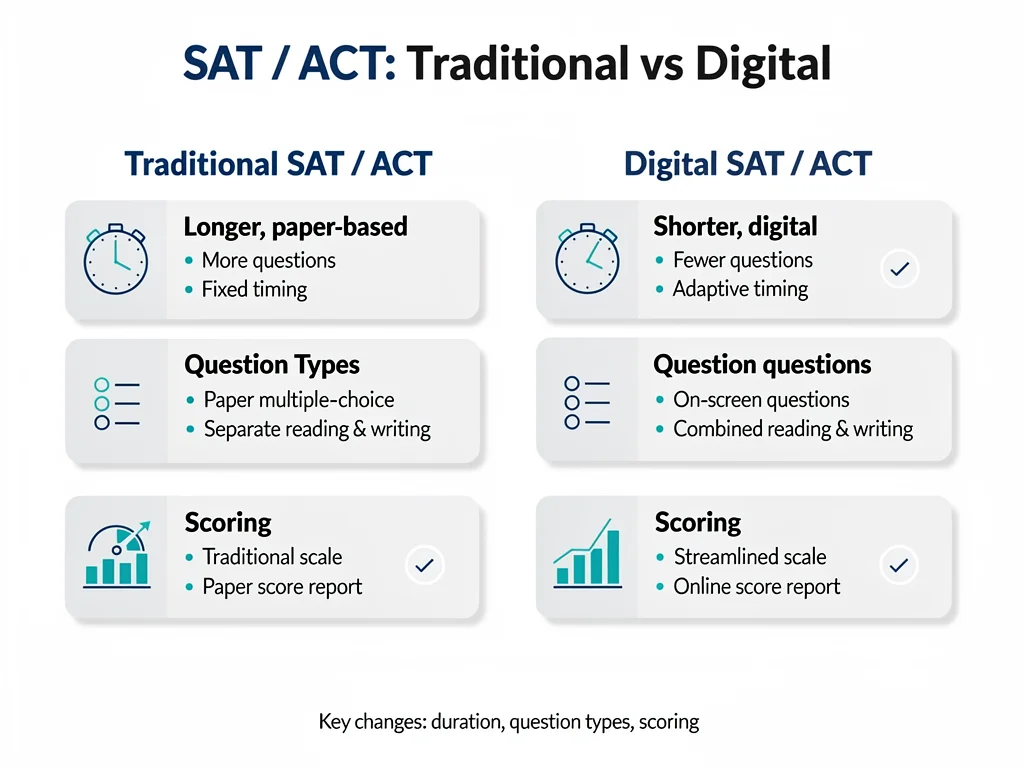
The College Board has fully transitioned the SAT to a digital format, bringing with it several key changes. This new version is shorter, adaptive, and administered on a computer or tablet. Understanding these structural differences is the first step towards effective preparation.
Adaptive Testing: The digital SAT employs a multi-stage adaptive design, meaning the difficulty of the second module for both Reading & Writing and Math depends on your performance in the first module. This requires consistent accuracy.
Shorter Test Duration: The digital SAT is approximately two hours and 14 minutes long, a significant reduction from the paper-based version. This means less test fatigue but requires sustained focus.
Integrated Calculator: A built-in graphing calculator is available for the entire Math section, reducing the need to bring your own and standardising access to tools.
New Question Types: While the core concepts remain, some question formats have been updated, particularly in the Reading & Writing section, which now features shorter passages and more direct questions.
The ACT’s Digital Evolution
While the ACT has not undergone as radical a shift as the SAT, it has also embraced digital testing options and continues to refine its content. For 2026, students should be aware of the availability of digital testing centres and potential minor updates to question styles.
The ACT remains a comprehensive assessment of English, Mathematics, Reading, Science, and an optional Writing section. Its digital version maintains the same question types and pacing as the paper test, but familiarisation with the digital interface is still crucial. Practising with official digital ACT tests will ensure comfort with navigation, annotation tools, and time management in a digital environment.
In conclusion, the 2026 SAT and ACT are not the same tests as those from previous years. Students must invest time in understanding their updated structures, digital formats, and adaptive elements. This foundational knowledge is the bedrock upon which successful preparation strategies are built, ensuring that efforts are aligned with the actual demands of the exams.
Crafting Your Personalised 2026 SAT/ACT Study Plan
A generic study plan rarely yields optimal results for everyone. To truly excel on the 2026 SAT/ACT, a personalised approach is essential. This involves a thorough self-assessment, setting realistic goals, and structuring your study time effectively to address individual strengths and weaknesses. The goal is not just to study more, but to study smarter, making every hour count towards improving your score.
Effective planning also means incorporating flexibility. Life happens, and an overly rigid schedule can lead to burnout or missed study sessions. Build in buffer time and be prepared to adjust your plan as you progress, learning what works best for your learning style and energy levels. This adaptable framework ensures sustained motivation and consistent progress.
Initial Assessment and Goal Setting
Before diving into content review, take a full-length diagnostic test for both the SAT and ACT. This initial assessment provides a baseline score and highlights specific areas where you need to focus your efforts. Don’t be discouraged by your initial score; it’s a starting point for growth.
Identify Weaknesses: Pinpoint specific content areas (e.g., algebra, geometry, grammar rules, reading comprehension strategies) and question types that consistently challenge you.
Set SMART Goals: Establish Specific, Measurable, Achievable, Relevant, and Time-bound score goals. For example, ‘Increase my Math section score by 50 points in three months.’
Choose Your Test: Decide whether you will focus primarily on the SAT, ACT, or both. Your diagnostic scores and preferred test format (e.g., speed vs. depth) can guide this decision.
Structuring Your Study Schedule
Once you have a clear understanding of your starting point and target scores, it’s time to build a realistic and sustainable study schedule. Consistency is more important than sporadic marathon sessions.
Allocate dedicated blocks of time each week for studying. Consider your existing commitments, such as school, extracurricular activities, and family obligations. Spreading your study over several months, rather than cramming, allows for better retention and reduces stress. For instance, dedicate specific days to certain subjects or practice test sessions, ensuring a balanced approach.
Your personalised study plan should be a living document, evolving as you progress. Regularly review your practice test results, identify areas of improvement, and adjust your focus accordingly. This iterative process ensures that your preparation remains targeted and efficient, leading to the best possible outcomes on the 2026 SAT/ACT.
Mastering Digital Test Formats: Strategies for Success
The shift to digital testing for the 2026 SAT/ACT brings a new set of challenges and opportunities. Adapting your test-taking strategies to the computer-based environment is just as crucial as mastering the content itself. Familiarity with the interface, tools, and pacing of digital exams can significantly reduce anxiety and improve performance.
Many students are accustomed to paper-based tests, where they can underline, circle, and flip through pages. Digital tests require different navigation and annotation skills. Practising extensively with official digital practice tests is the most effective way to build comfort and proficiency with the new format, ensuring no surprises on test day.
Navigating the Digital Interface
Each digital test platform has its own unique layout and features. Becoming proficient with these tools before test day can save precious time and prevent frustration.
Practice with Official Tools: Utilise the College Board’s Bluebook app for the digital SAT and official ACT digital practice tests. Explore all available features, such as the built-in calculator, annotation tools, flagging questions, and timer.
Time Management: The digital tests have on-screen timers. Practise pacing yourself using these timers, as the visual representation can feel different from a physical stopwatch. Learn to quickly identify how much time you have left for each section.
Digital Annotations: While you can’t physically mark up a digital screen, learn to use the digital annotation tools effectively. Highlighting key phrases or crossing out incorrect answer choices digitally can mimic your paper-based strategies.
Adaptive Testing: A Strategic Approach
For the digital SAT, the adaptive nature of the test requires a slightly different strategic mindset. Your performance on the first module directly influences the difficulty of the second, making every question count.
Focus on accuracy from the very beginning. Don’t rush through the first module, as a strong performance here can lead to a more challenging second module, which in turn offers the opportunity for a higher score. Similarly, don’t dwell too long on any single question; if you’re stuck, make your best guess and move on, ensuring you complete all questions within the time limit. Remember, there’s no penalty for guessing.
Ultimately, success in the digital SAT/ACT hinges on more than just content knowledge. It requires a strategic understanding of the test’s format, efficient use of digital tools, and a calm, focused approach to adaptive challenges. Regular practice in the actual digital environment is the key to mastering these elements and optimising your performance.
Deep Dive into Content: What to Focus on for Each Section
While the format of the 2026 SAT/ACT has evolved, the core academic skills being tested remain fundamental. A deep understanding of the content tested in each section is indispensable for achieving top scores. This involves not just reviewing concepts but also understanding how those concepts are applied in test questions and identifying common traps.
Each section of both tests assesses distinct areas of knowledge and critical thinking. Tailoring your content review to the specific demands of each section, whether it’s the nuances of grammar, complex mathematical problem-solving, or efficient reading comprehension, will ensure your study time is highly effective and targeted.
SAT Reading & Writing Section
The digital SAT’s Reading & Writing section has been streamlined, featuring shorter passages and a more direct question style. This section assesses your ability to comprehend and analyse text, as well as your command of standard English conventions.
Reading Comprehension: Focus on identifying main ideas, author’s purpose, evidence-based reasoning, and understanding vocabulary in context. Practise reading a variety of text types, from literary fiction to scientific passages.
Standard English Conventions: Review grammar rules, punctuation, sentence structure, and precise word choice. Pay attention to common errors like subject-verb agreement, pronoun-antecedent agreement, and parallelism.
Rhetorical Synthesis: This involves understanding how different parts of an argument function and how to effectively combine information. Practise identifying claims, evidence, and counterarguments.
SAT Math Section
The Math section of the digital SAT covers Algebra, Advanced Math, Problem-Solving and Data Analysis, and Geometry and Trigonometry. A strong foundation in these areas is crucial.
Focus on conceptual understanding rather than just memorising formulas. Practise applying mathematical principles to real-world scenarios. The integrated calculator means you should also be proficient in using its functions efficiently. Work through a wide range of practice problems, paying attention to both multiple-choice and grid-in questions to ensure you are comfortable with both formats.
ACT English, Math, Reading, and Science
The ACT maintains its distinct sections, each requiring specific preparation strategies. The English section tests grammar and rhetoric, while Math covers a broader range of topics up to pre-calculus. Reading assesses comprehension of various prose types, and Science evaluates data interpretation and scientific reasoning.
For the ACT Science section, focus on interpreting graphs, charts, and experimental data rather than recalling specific scientific facts. For the English section, practise identifying grammatical errors and improving the clarity and conciseness of sentences. The Math section requires a solid grasp of algebra, geometry, and trigonometry, often in a fast-paced environment. Finally, for Reading, work on quickly identifying main ideas and supporting details across different passage types.
A deep dive into the content of each section, coupled with targeted practice, is the most effective way to build the knowledge and skills required for top scores on the 2026 SAT/ACT. Don’t just study; understand the ‘why’ behind the correct answers and the ‘how’ of applying concepts.
Leveraging Practice Tests and Analytics for Score Improvement
Taking practice tests is only half the battle; the real gains come from analysing your performance. For the 2026 SAT/ACT, leveraging analytics from practice tests is a powerful strategy for identifying patterns in your errors, refining your approach, and ultimately boosting your scores. This analytical phase transforms practice into purposeful learning.
Beyond simply reviewing incorrect answers, it’s vital to understand why those answers were wrong. Was it a content gap, a misinterpretation of the question, a time management issue, or a careless error? Detailed analysis provides actionable insights that can guide your subsequent study sessions, making them far more efficient and effective.
Detailed Error Analysis
After each full-length practice test, dedicate significant time to a thorough review of every question, not just the ones you got wrong. This process is often more valuable than taking another test immediately.
Categorise Mistakes: Classify your errors by type (e.g., conceptual misunderstanding, misreading the question, calculation error, time pressure, careless mistake).
Identify Patterns: Look for recurring issues. Are you consistently struggling with a particular math concept, a specific type of reading question, or certain grammar rules?
Review Correct Answers: For questions you answered correctly, consider if you used the most efficient method or if there was an element of luck involved. Understanding why you got it right reinforces good habits.
Using Analytics to Refine Your Strategy
Many online platforms and official practice tests provide detailed score reports and analytics. Utilise these resources to gain deeper insights into your performance.
These analytics can show you which subtopics within a section are your weakest, how long you spent on each question, and how your performance compares to others. Use this data to tailor your study plan, allocating more time to your weakest areas and practising the specific question types that challenge you most. This data-driven approach ensures your preparation is always focused on where it can make the biggest impact on your score.
In essence, practice tests are diagnostic tools. By meticulously analysing your results and using the insights gained to refine your study plan and test-taking strategies, you transform raw practice into targeted improvement. This analytical approach is a cornerstone of achieving top scores on the 2026 SAT/ACT.
Beyond Academics: Holistic Preparation for Test Day
Achieving top scores on the 2026 SAT/ACT involves more than just academic preparation; it requires a holistic approach that includes managing stress, maintaining physical well-being, and developing effective test-day strategies. Your mental and physical state can significantly impact your performance, regardless of how well you know the material.
Ignoring these non-academic factors can undermine months of diligent study. A well-rested, calm, and focused mind is your greatest asset on test day. Therefore, integrating self-care and strategic planning into your overall preparation is not just beneficial, but essential for maximising your potential.
Managing Test Anxiety and Stress
Test anxiety is a common challenge, but it can be managed with effective techniques. Recognising the signs of anxiety and having strategies to cope can make a big difference.
Mindfulness and Relaxation: Practise deep breathing exercises, meditation, or progressive muscle relaxation. Short breaks during study sessions can also help clear your mind.
Positive Self-Talk: Challenge negative thoughts and replace them with positive affirmations. Focus on your preparation and capabilities rather than potential failures.
Simulate Test Conditions: Practising under timed, test-like conditions can reduce anxiety on the actual day by making the experience familiar.
Physical Well-being and Nutrition
Your physical health directly influences your cognitive function. Prioritising sleep, nutrition, and exercise can enhance your focus, memory, and energy levels.
Aim for 7-9 hours of quality sleep each night, especially in the week leading up to the test. On test day, eat a balanced breakfast that includes protein and complex carbohydrates to sustain energy and focus. Stay hydrated, but avoid excessive caffeine. Regular physical activity can also help reduce stress and improve mental clarity, making it easier to absorb and recall information during your study sessions.
Strategic Test Day Execution
Having a clear plan for test day can help minimise surprises and keep you calm and focused.
Know the test centre location and plan your route in advance. Pack your necessary items (ID, approved calculator, water, snacks) the night before. Arrive early to settle in without rushing. During the test, pace yourself, take advantage of breaks, and avoid dwelling on difficult questions. Trust your preparation and focus on one question at a time. A calm and strategic approach ensures you can perform at your peak.
Holistic preparation ensures that you are not only academically ready but also mentally and physically prepared to perform your best on the 2026 SAT/ACT. By addressing these crucial non-academic aspects, you create an optimal environment for success.
Key Strategy
Brief Description
Understand Digital Formats
Familiarise with digital SAT/ACT interfaces, adaptive testing, and new question types.
Personalised Study Plan
Create a schedule based on diagnostic tests, targeting weaknesses and setting SMART goals.
Leverage Practice & Analytics
Take full-length practice tests and conduct detailed error analysis to refine strategies.
Holistic Preparation
Manage stress, prioritise sleep and nutrition, and plan test-day logistics for optimal performance.
Frequently Asked Questions About 2026 SAT/ACT Preparation
What are the biggest changes to the SAT for 2026?▼
The SAT is now fully digital, shorter (2 hours 14 minutes), and adaptive. It features a built-in calculator for all math sections and new question types, especially in the Reading & Writing section, which uses shorter passages. These changes require specific digital preparation.
How should I choose between the SAT and ACT for 2026?▼
Take full-length diagnostic tests for both. Compare your scores and consider which test format better suits your strengths. The SAT is now adaptive and shorter, while the ACT covers more science-based reasoning and has a faster pace per question. Your preferred style should guide your choice.
Is an online prep course sufficient, or do I need a tutor for 2026 exams?▼
Online courses can be highly effective for self-motivated students who benefit from structured content and practice. A tutor offers personalised feedback and targeted strategies for specific weaknesses. The best choice depends on your learning style, budget, and how much individualised support you need.
How important is understanding the digital interface for the 2026 tests?▼
Extremely important. Familiarity with the digital interface, including navigation, annotation tools, and the on-screen calculator/timer, can significantly reduce test-day anxiety and improve efficiency. Practising with official digital tools is crucial to avoid surprises and maximise your score.
What role does mental preparation play in achieving top scores?▼
Mental preparation is vital. Managing test anxiety through mindfulness, positive self-talk, and simulating test conditions helps maintain focus and reduce stress. Adequate sleep, nutrition, and physical activity also contribute significantly to cognitive function and overall performance on test day.
Conclusion
Achieving top scores on the 2026 SAT/ACT in the US demands a multi-faceted and informed approach. The evolving digital formats of both exams necessitate a shift in preparation strategies, moving beyond traditional methods to embrace adaptive learning, digital tool proficiency, and targeted content mastery. By understanding the specific changes, crafting a personalised study plan, meticulously analysing practice test results, and prioritising holistic well-being, students can confidently navigate these critical assessments. Success is not merely about intelligence, but about strategic preparation, adaptability, and resilience, ensuring that every student has the opportunity to showcase their full potential for college admissions.
A journalism student and passionate about communication, she has been working as a content intern for 1 year and 3 months, producing creative and informative texts about decoration and construction. With an eye for detail and a focus on the reader, she writes with ease and clarity to help the public make more informed decisions in their daily lives.